
A free point of sale for shops and restaurants
A counter till, a dining room with tables, and a kitchen screen — all posting to the same books, and reconciled at the end of every shift.
Start free — two minutes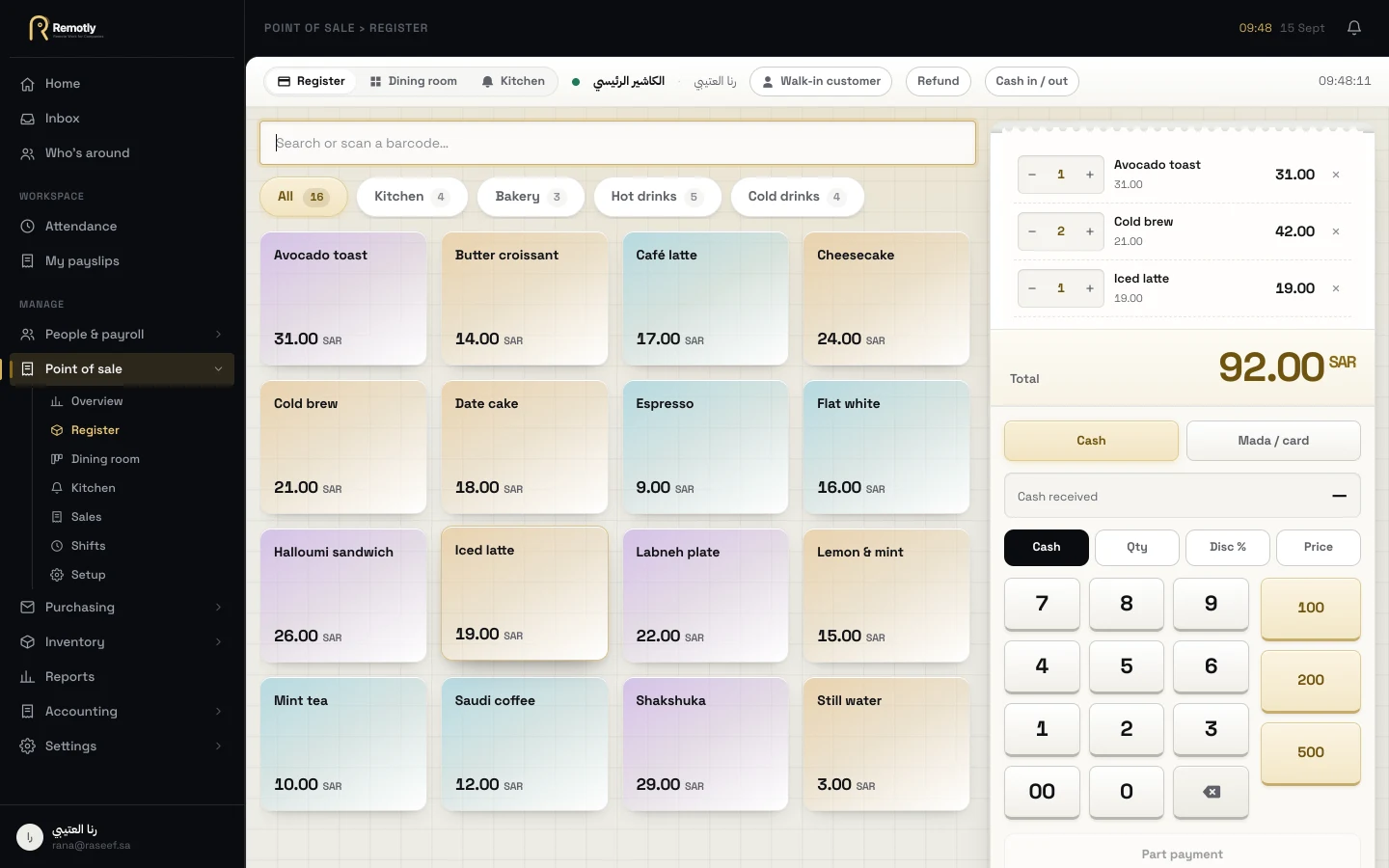
Fast counter
Products as tiles, a keypad for quantity, price and discount, and one key to charge.
Tables & bills
Seat a party, split the bill, move it to another table, or merge two parties into one.
Kitchen screen
What was fired, how long ago, and what is late — with no prices and no way to sell.
Two tenders, one sale
Part in cash and the rest on a card, with the change worked out and the receipt showing both.
Built for the way a service actually runs
Four people at a table ask to pay separately. Two friends who sat apart want one bill. A party moves to the terrace because the sun came round. A till that cannot do those three things sends the waiter back to a notepad, and the notepad is where the money goes missing.
Remotly splits a bill by whole items rather than by fractions of a dish, because a plate already with the kitchen cannot be half on one ticket and half on another. Tables move with their bill attached. Two bills merge and the guest count follows. Each resulting ticket is a real ticket — it prints, it takes payment, and it lands in the same shift.
- Split a bill, move a table, merge two parties — from one button on the ticket.
- An even split across two, three or four ways, with the rounding landing on the last payer.
- Order notes that reach the kitchen — no onions, extra spicy — attached to the line, not shouted.
- Refunds against the original sale, so a return is a record and not a hole in the drawer.
Selling a dish takes its ingredients out of the store
Give a dish a recipe and every sale moves the ingredients out of stock automatically. A shawarma sandwich takes its bread, its meat and its sauce; a mixed platter made in the morning is produced once as a batch and then sold from stock like anything else. Nobody types a stock adjustment at the end of the night, because there is nothing left to adjust.
A refund puts the ingredients back. A shop that sells goods rather than dishes gets the same behaviour without writing a single recipe: the item sold leaves the shelf and appears against the customer, and the company’s stock still adds up.
The drawer has to balance, per method
A shift that takes half its money on cards and counts all of it as cash never reconciles, and the error grows by the card total every single day. Remotly books each payment method to its own account: cash to the drawer, cards to the bank account they actually settle into. At close you count the cash, and what you count is compared against what should be there — not against the day’s total.
Money taken out of the drawer for a delivery, or put in as a float, is recorded as a movement with a reason. A sale invoiced to a company account is excluded from the expected cash, because nothing went into the drawer.
Money written the way your currency is written
In Kuwait, Bahrain, Oman and Jordan money carries three decimal places, not two. A till that assumes two rejects a split payment on a bill of 12.345 with an arithmetic error the cashier cannot see. Remotly counts in the company’s own currency and its real number of digits, on the counter screen and on the restaurant bill alike.
Common questions
Does it work for a shop as well as a restaurant?
Yes. The counter register is the default; the dining room, tables and kitchen screen appear for the companies that lay a floor out. A shop never sees them.
Do I need special hardware?
No. It runs in a browser on a laptop, a tablet or a phone. A receipt prints from the browser, and network printers can be recorded for the kitchen.
Is it certified for e-invoicing?
No. Remotly issues a tax invoice from a sale when you ask for one, carrying the rates your company configured, and makes no compliance claim for any country’s e-invoicing regime.
What happens if the same sale is sent twice?
It is recorded once. Each sale carries a key from the device, so a cashier who taps again after a slow network sees the sale that already went through rather than charging the customer twice.